Tankless capacity is a rate, not a promise: gallons per minute at a temperature rise. Dallas winter water arrives in the low-to-mid 50s, so a unit's January delivery is far below its brochure number - size for January.
Problem: Tankless capacity is a rate, not a promise: gallons per minute at a temperature rise. Dallas winter water arrives in the low-to-mid 50s, so a unit's January delivery is far below its brochure number - size for January.
Solution: The yearly descale is mandatory in Dallas's moderately hard water. Isolation and service valves at install are what make that service possible - an install without them is unmaintainable by design.
When to call: Tankless wins for households whose peak fits one unit's winter rate and who will keep the maintenance rhythm. It loses to a good tank for very high peaks and for owners who will not maintain - honestly stated, both are fine answers.
Tankless water heaters are the most oversold and under-explained appliance in Dallas plumbing - sold on 'endless hot water' and installed, too often, on summer arithmetic. This guide is the pre-purchase briefing the brochure skips: the flow-and-temperature math that decides whether a unit will serve your household in January, the gas and venting scope an installation really involves, the maintenance contract you sign with the technology (yearly descaling in Dallas water), and the household profiles where tankless is brilliant versus where a high-quality tank is the smarter, cheaper happiness.
The Dallas Angle
The third constant is the sky's mood swings. North Texas summers push attic temperatures to extremes that age everything stored there - including the water heaters Texas builders insist on installing in them - while winters are mild until they are not: the February 2021 Winter Storm Uri froze and burst pipes across the metroplex, and every hard front since has replayed the lesson at smaller scale. Dallas plumbing is designed, repaired and winterized against that swing: pipes in exterior walls and crawl spaces are liabilities one week a decade, and certainties on a long enough calendar.
The math: flow at a rise, in January
A tankless unit is rated in gallons per minute at a specified temperature rise. Dallas winter water enters in the low-to-mid 50s Fahrenheit; a shower wants roughly 105-110 degrees at the head, fed by a 120-degree setpoint mixed with cold. The rise the unit must deliver in January is therefore fifty degrees or more - and a unit advertised at 9 gpm at a gentle 35-degree rise may deliver near 5 gpm at a January rise. Now the household's peak: a shower draws about 2 to 2.5 gpm of total flow (hot fraction roughly two-thirds), so two showers plus a dishwasher's fill plus a laundry load can meet or exceed 5 gpm of hot demand. That collision - brochure rate versus January peak - is where tankless disappointment is manufactured.
The professional response is profiling: inventory the household's worst fifteen minutes in the coldest month, and size the unit (or a pair, or a different technology) to that number with margin. Recirculation, where fitted, solves the wait, not the rate. Groundwater temperature maps exist for exactly this calculation, and any installer who quotes a unit without asking about your household's simultaneous uses is selling a box, not a system.
The install scope nobody puts on the flyer
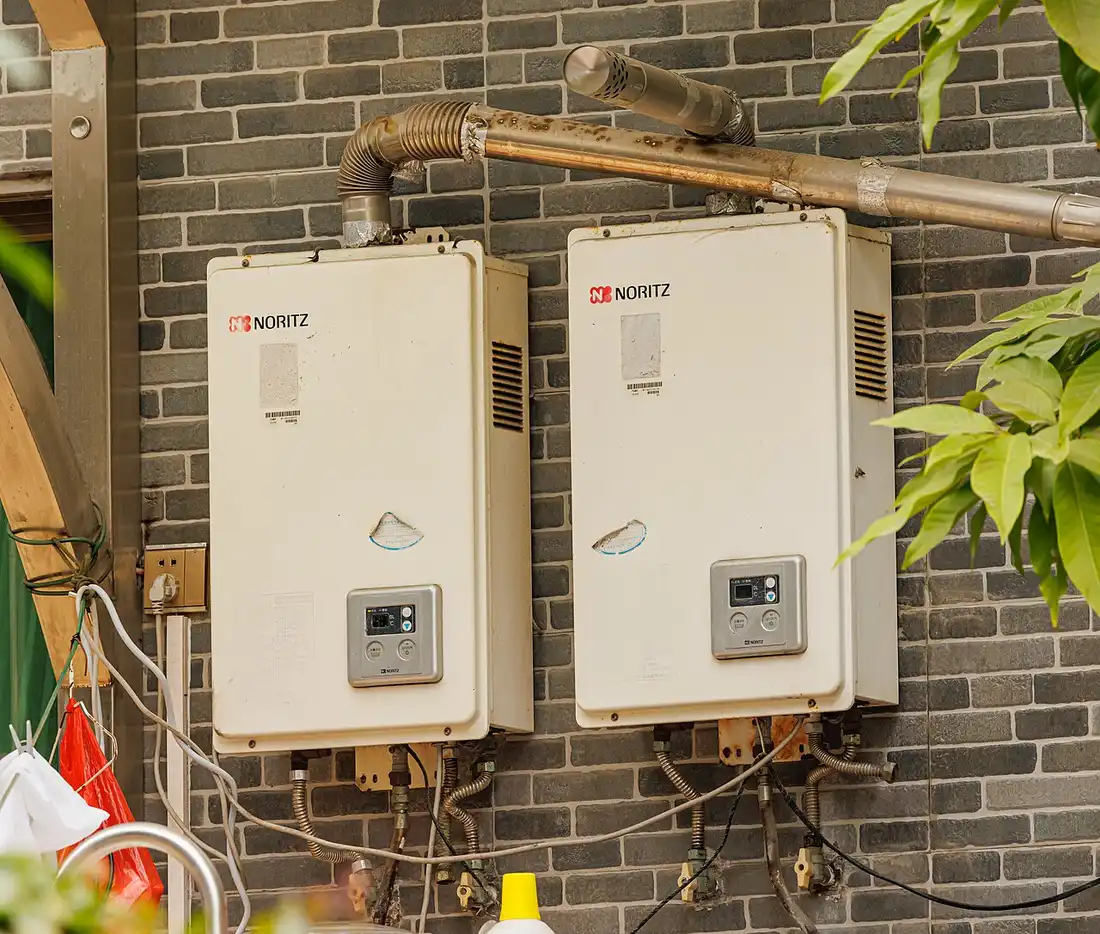
A tankless retrofit is a small construction project wearing an appliance's clothes. The gas line usually upsizes - a tankless burner draws several times a tank's rate, and the line and sometimes the meter capacity must be recalculated. Venting is new: sealed-combustion runs in PVC or stainless, routed by rules different from the old flue. Condensing models add a condensate drain (and its neutralization, where required). Controls need power. The mounting location - garage, exterior wall, or attic with its freeze and drain considerations - shapes the whole job. Permits and inspection cover the gas and venting.
Two install details decide the ownership experience. Service and isolation valves: the fittings that let a descale pump circulate through the exchanger - without them, the mandatory yearly service becomes a plumbing project. And freeze protection for the unit's lines: the heater has internal safeguards, but its exposed piping in a Dallas attic or exterior mount lives by the same rules as any pipe in a Uri. A quote that shows these items understands the technology; one that shows only a unit price understands the sale.
PROBLEM
→
SOLUTION
Ownership: the descale rhythm and the honest verdict
Dallas water scales heat exchangers the way it sediments tanks, faster because the passages are narrower. The yearly descale - a pump, hoses, descaling solution circulated through the service valves for the better part of an hour - restores the exchanger and is the non-negotiable rent on the technology's twenty-year life. Add the inlet filter screen's rinsing and attention to error codes (the unit reports flow, ignition and scale conditions in its own language), and ownership is a rhythm of small attentions rather than a decade of neglect ending in a flood - a trade many households prefer, and some honestly should not make.
The verdict, by household: high simultaneous demand with maintenance discipline - tankless, sized honestly. Moderate demand, attic tank anxiety, irregular occupancy (standby losses vanish) - tankless shines. Very high peaks on a budget, gas infrastructure that cannot grow, or a household that will not descale - a premium tank with a pan, a drain that drains and a leak alarm is the wiser buy, and any installer who says so has earned your trust for whichever you choose.
Two-unit and hybrid arrangements
When one unit's winter rate cannot meet the peak, the honest options multiply rather than disappear: two tankless units in parallel (capacity adds, and redundancy comes free - one unit down is a smaller emergency), a tankless paired with a small tank as a buffer for a soaking tub's surge, or a high-recovery tank alone. Large Dallas homes, especially two-story layouts with distant bathrooms, also split the difference geographically - a unit per zone - which shortens runs and waits together. The profile drives the architecture; there is no household whose honest answer is 'the brochure unit, hopefully.'
Cost comparisons should be made at the system level: two units with their gas and venting versus one premium tank with its defenses - and over the technologies' different lifespans. The twenty-year tankless horizon against the tank's ten changes the arithmetic for owners who plan to stay.
Error codes: the unit's own testimony
Tankless units report themselves with unusual candor: flow-related codes when scale narrows the exchanger or the inlet screen clogs; ignition codes after gas interruptions or with venting obstructions; temperature codes when demand exceeds the setpoint's physics. Owners who keep the manual's code page learn to separate the homeowner tier (screen, reset after an outage, check the vent termination for a wasp nest) from the professional tier (burner, gas valve, exchanger). That literacy converts most 'failures' into ten-minute resolutions and reserves service calls for the real ones.
It also disciplines the descale conversation: a unit that begins throwing flow codes at month eight is not defective - it is reporting Dallas water's arithmetic and asking for its rhythm early. The code is the calendar, speaking up.
Myth vs Fact
The Myth
Tankless units never run out of hot water, period. They never run out in time - and absolutely can in rate. The sentence that sells the technology omits its unit of measure: gallons per minute at a temperature rise. In a Dallas January, that omission is the difference between a delighted household and a cold one with a new appliance.
VS
The Fact
Groundwater temperature is the hidden spec in every tankless decision. The same unit is a hero in a mild climate and marginal in a cold snap, purely on inlet temperature. Dallas's low-50s winter water is the number the sizing must use - any quote that does not mention inlet temperature has not done the math your January will test.
The Related Service, In Depth
The tankless ownership bargain, stated plainly: you trade a large, dumb, forgiving appliance for a small, smart, demanding one. The tank forgave neglect for years before failing; the tankless reports neglect as error codes and lukewarm showers within a season or two in Dallas water. Owners who like systems - who keep calendars and enjoy a machine running at spec - are delighted for twenty years. Owners who want to forget the appliance exists should buy the best tank and a leak alarm. Neither answer is a failure of the technology; both are the technology honestly matched to its keeper.
That is the service side of this guide's subject. When you are ready, the Tankless Water Heaters page carries the process, the coverage by neighborhood and the number to call.
The Process, Step by Step
Profile your peak honestly
List the fixtures that run together in your worst fifteen January minutes, with their flows. Optimism here is purchased back later, in cold showers.
Get the winter math in writing
The unit's gallons per minute at a 50-plus-degree rise, set against your profiled peak. Any quoter who will not state the winter number has not done the sizing.
Audit the utilities before choosing the unit
Gas capacity and line route, vent path, condensate disposal, power, mounting location with freeze protection. The audit occasionally decides against tankless - honestly.
Require service valves in the install scope
Isolation and service valves are what make the mandatory yearly descale a service instead of a surgery. And the first descale date goes on the calendar before the installer leaves.
Commission properly
Setpoints set for the household, error codes explained from the manual's short list, recirculation scheduled to your hours if fitted. The first year's setup earns the second decade.
Prevention Checklist
Descale yearly in Dallas water - the exchanger keeps the score and reports it as flow codes and temperature swings.
Rinse the inlet filter screen on schedule; it is the unit's first and least costly defense.
Freeze-protect exposed feed lines; the unit's safeguards do not extend to the pipes serving it.
Keep vent terminations clear - mulch, nests and stored items all find their way to them.
Learn your error codes from the manual's short list: the unit tells you what it needs, in order, if you read it.
A Field Checklist for Your Own Home
Write your household's worst fifteen minutes
fixtures, overlaps, season. Be honest, not optimistic.
Learn your current heater's age and your gas line's story before shopping - the audit starts at home.
Decide your maintenance temperament in advance: yearly descale, by you or by a service - or choose the tank with open eyes.
Ask every quoter one question
'What will this unit deliver at a 55-degree rise?' Keep the answers.
What the Paperwork Should Show
A professional tankless scope includes: the peak profile and winter sizing calculation, the gas capacity and line audit, venting and condensate design, mounting with freeze protection addressed, service and isolation valves fitted, permits and inspection, commissioning with setpoints and codes explained, and the first descale date set. The unit's price is one line in that scope - and not the largest determinant of your next twenty years.
A conversion scope from an attic tank adds the location engineering: where the unit lives, how its lines are protected, and what happens to the old tank's flood inventory (it disappears - often the conversion's most valuable line item, priced in ceilings that never stain).
How a Professional Works This Problem
Real tankless professionals sell the January number: they profile the household's peak, state the unit's delivery at winter rise, and put the gas and venting audit before the model recommendation. Their installs show their seriousness - service valves fitted, condensate handled, first descale scheduled. The tell of the box-seller is a quote with a model number and no questions; the tell of the professional is a quote that began with your Saturday morning.
Mistakes That Make It Worse
Sizing on the brochure's warm-climate rating and discovering the truth at the first January houseful of guests.
Skipping the gas-line audit, then troubleshooting 'defective' units that are simply starved.
Installing without service valves, converting every yearly descale into a plumbing alteration.
Treating the first flow-related error code as a malfunction to reset repeatedly, rather than the descale calendar announcing itself.
The Bottom Line
Tankless is a superb technology with an honest fine print: winter math and yearly care. Read the fine print before you buy, and the technology will read as a promise kept for twenty years.
If you smell gas - the rotten-egg odor - leave the house and call Atmos Energy or 911 from outside. No switches, no searching, no re-entry. This rule outranks everything else in this guide.
Plumbing prices are built from factors, not pulled from a chart: what failed, where it sits (slab, wall, attic, yard), how much must be opened to reach it, the materials involved, and what the opened work reveals.
How long will hot water take to reach my far bathroom?
Tankless adds a few seconds of ignition-and-ramp to the pipe run's natural wait - the distance from heater to fixture dominates. Homes bothered by the wait solve it with recirculation (built-in or added), which keeps hot water staged near the fixtures on a schedule. It is a comfort option to decide at install, when it is least costly.
Can one tankless serve a large Dallas home?
If the January peak fits one unit's real rate, yes. Larger or peak-heavy homes use two units in parallel, or keep a hybrid arrangement. The profile decides - a five-bathroom house with simultaneous morning demand is a math problem, and the math is knowable before purchase.
What happens during a power outage?
A tankless unit needs electricity for its controls, fan and ignition - no power, no hot water, even on a gas unit. (A tank heater with a standing pilot keeps its stored hot water available; a power-vented tank does not.) Households planning for outages pair accordingly - a fact worth one line in the decision.
Is the yearly descale really necessary in Dallas, or is it a service upsell?
It is the technology's physics in moderately hard water: scale insulates the exchanger, the unit derates and eventually errors, and neglected exchangers fail years early. The descale is to tankless what the flush is to a tank - except the tank forgives skipping longer. Owners can perform it with a pump kit and the manual; what they cannot do is skip it and keep the warranty-era lifespan.
Please note: Dallas Plumbing Pros is an independent directory and referral service, not a plumbing contractor. The professionals reachable through this site are independent businesses; any agreement for work is between you and the professional you engage. Service information on this site is general educational material - the scope of any real plumbing work is set by an on-site inspection.
A Burst Pipe, a Backed-Up Drain or a Water Heater Gone Cold?
One call connects you with a plumbing professional serving Dallas and the surrounding communities - diagnosis, repair and a clear scope before work starts.